ATS Readability Check
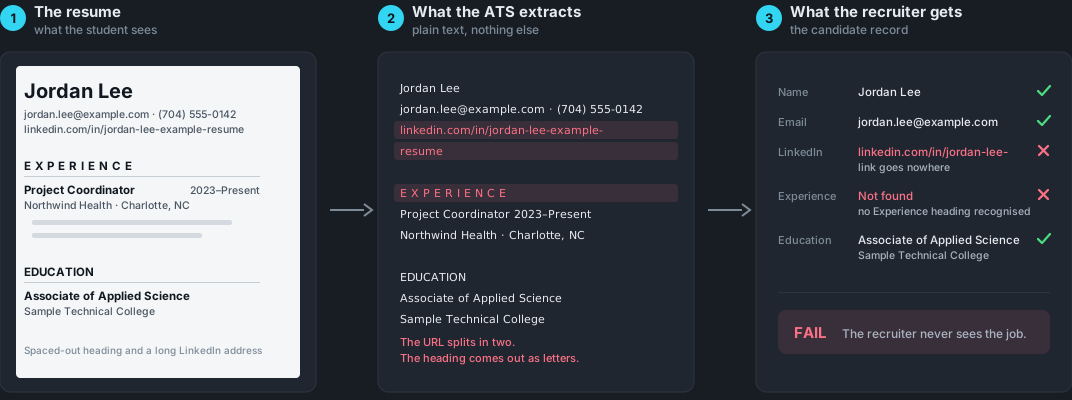
Before a recruiter sees a resume, an applicant tracking system turns the PDF back into plain text. Sections, job titles, dates and contact details are all parsed from that text. If it comes out broken, the recruiter never sees what the candidate wrote. We built a check that shows exactly what comes out.
1Reads the downloaded PDF
It works on the exact file a student would attach to an application. It runs outside the resume builder, so it sees only what an employer’s system sees: the PDF, nothing else.
2Extracts the text two ways
Two different open-source text extractors read every file. Tracking systems use different libraries, so a resume has to come through both.
3Checks every line that matters
Each heading, degree, job title, name, email, phone number and link is compared with what came out. Letter spacing is measured from the PDF itself, because spaced-out capitals are a common cause of broken headings.
4Builds the candidate record
It parses the extracted text into the record a recruiter would see, with name, contact details, work history and education, so a problem shows up the way it would in practice.
Every line came through whole.
Everything came through, with something worth knowing, such as letter spacing.
At least one heading, title, email or link came out broken.
Every resume template in SkillsFirst has been tested, in standard and compact layouts, at small, middle and large font sizes. SkillsFirst is the career readiness platform operated by the same company as Semantic Insight.
The test resume is built to find weak spots: a long LinkedIn address, an ordinary email, and all-caps headings and job titles. When a template doesn’t come through cleanly, we fix the template and test it again.
What it is, and isn’t. The check reproduces the first step every tracking system takes. It isn’t any vendor’s parser, and real systems do more with the text afterward. But they all start from it, so a line that comes out broken here is at risk everywhere. Nothing is stored: each file is processed in memory and discarded.
Want to see it run on your own resume templates?
Request a demonstration