Workforce Pell · Section 83002

Where Semantic Insight fits in the Workforce Pell process

The harder question isn't how to document Workforce Pell compliance. It's which programs to submit — and which occupation to anchor each one to. These are the tools we built to answer both.

Our tools for Workforce Pell readiness

Six stages to a defensible submission

The Readiness Review is the starting point: your catalog run against your state's actual gates, program by program, within a week — before your state's next window. These are the stages behind it, and what comes after approval. A live Pathways Analysis on the services page shows the evidence engine first.

Before any of this

The qualifying year

A program must already have run for twelve months at the compliant length — at least 8 but under 15 weeks, 150 to 599 clock hours — before it can apply. 34 CFR 690.94(a)(1). Pell pays enrolled students, so nothing is retroactive: that first cohort is funded by someone other than Workforce Pell.

Stage 1

Job Title Testing

Before we can rate any occupation as qualifying, we have to find the job titles employers actually use. This is the foundation step — and the record of every title we tested is yours to keep.

Stage 2

Workforce Pell Program Sweep

Green / yellow / red rating across your full short-term catalog — every program evaluated against the three statutory prongs with the evidence behind each call, then sorted by where it actually stands against the qualifying year.

Stage 3

Occupation Selection

A state list of several hundred eligible occupations names what qualifies. It does not say which one your region will hire. The federal crosswalk maps most programs to multiple candidates; we lay them side by side — wage, demand, and task coverage — so the choice is documented, not guessed.

Stage 4

Program Design Guide

Once the occupation is selected, what should the program teach? Regional employer duty frequency — ranked, tagged for emerging signals, with the actual posting language behind each one.

Stage 5

State Approval Evidence Package

A per-program PDF with the statutory evidence a state reviewer needs. The submission deliverable.

Stage 6

Placement

Approval gets the program eligible; staying eligible means a 70 percent placement rate the state computes from wage records. The state measures placement; the Placement System is how a program moves it — per certified program, per year, on SkillsFirst.

See it in action

Five stages of the process

Click through to see the actual tools — from job title testing through statutory proof.
semanticinsight.tech/workforce-pell?id=…
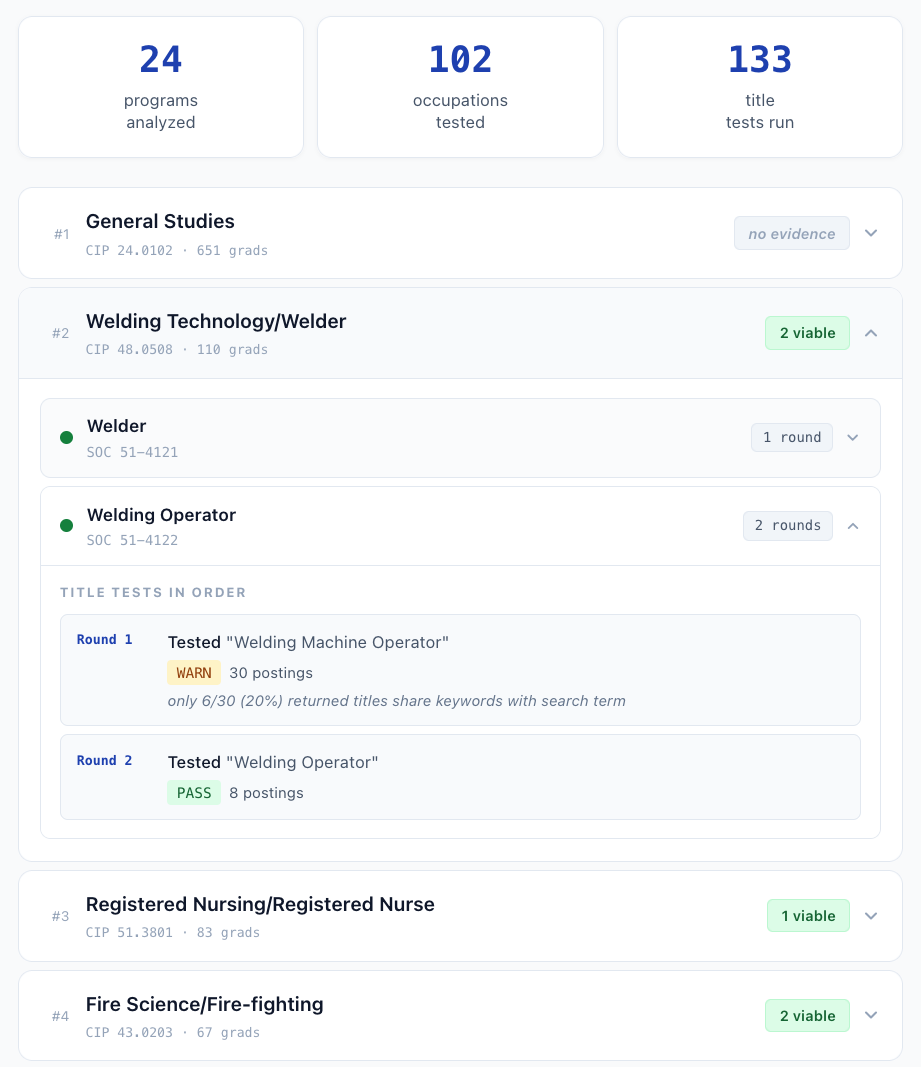
Occupation screening record showing which job titles were tested each round and posting counts returned
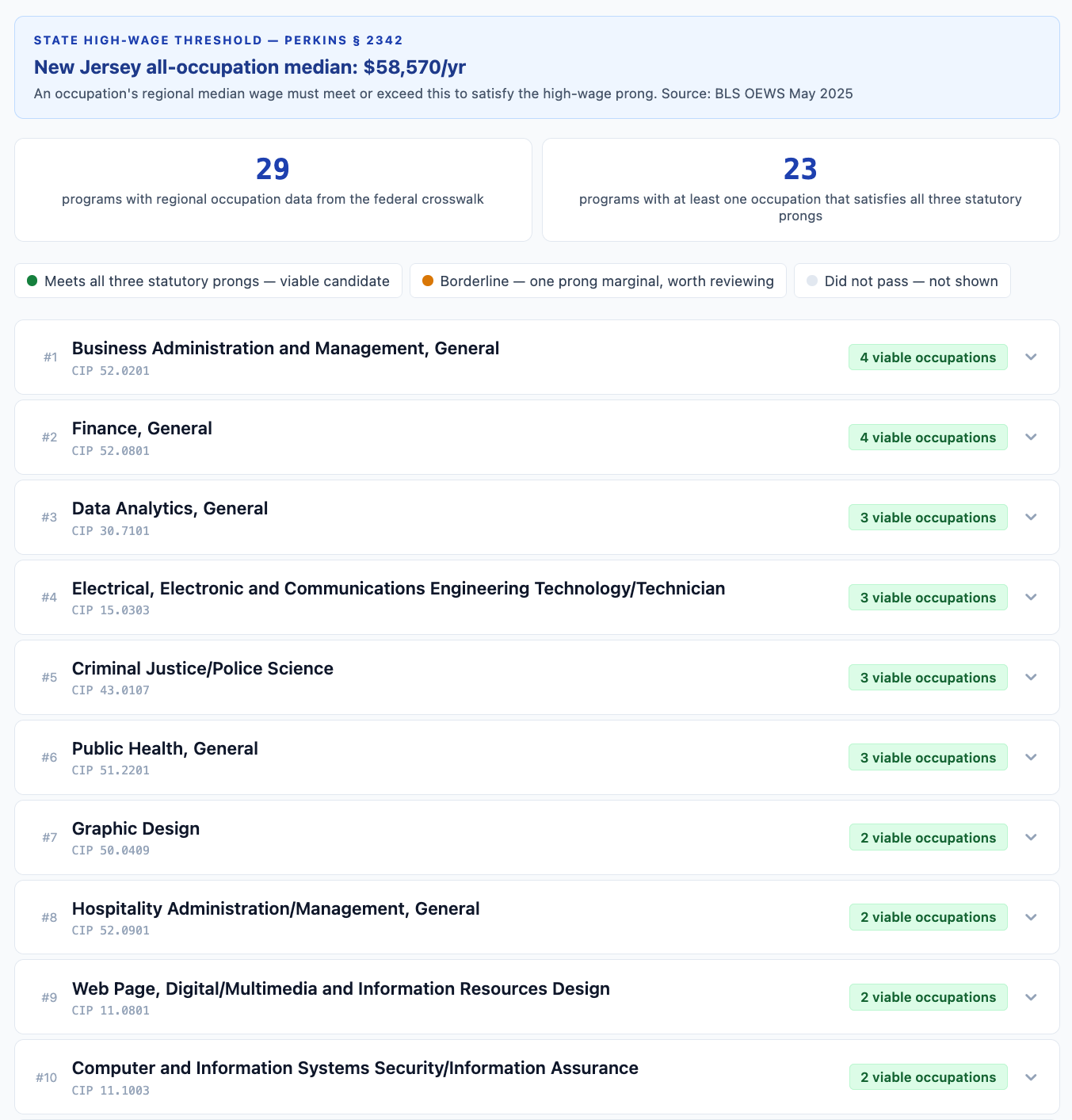
Programs ranked by viable occupation count against all three statutory prongs
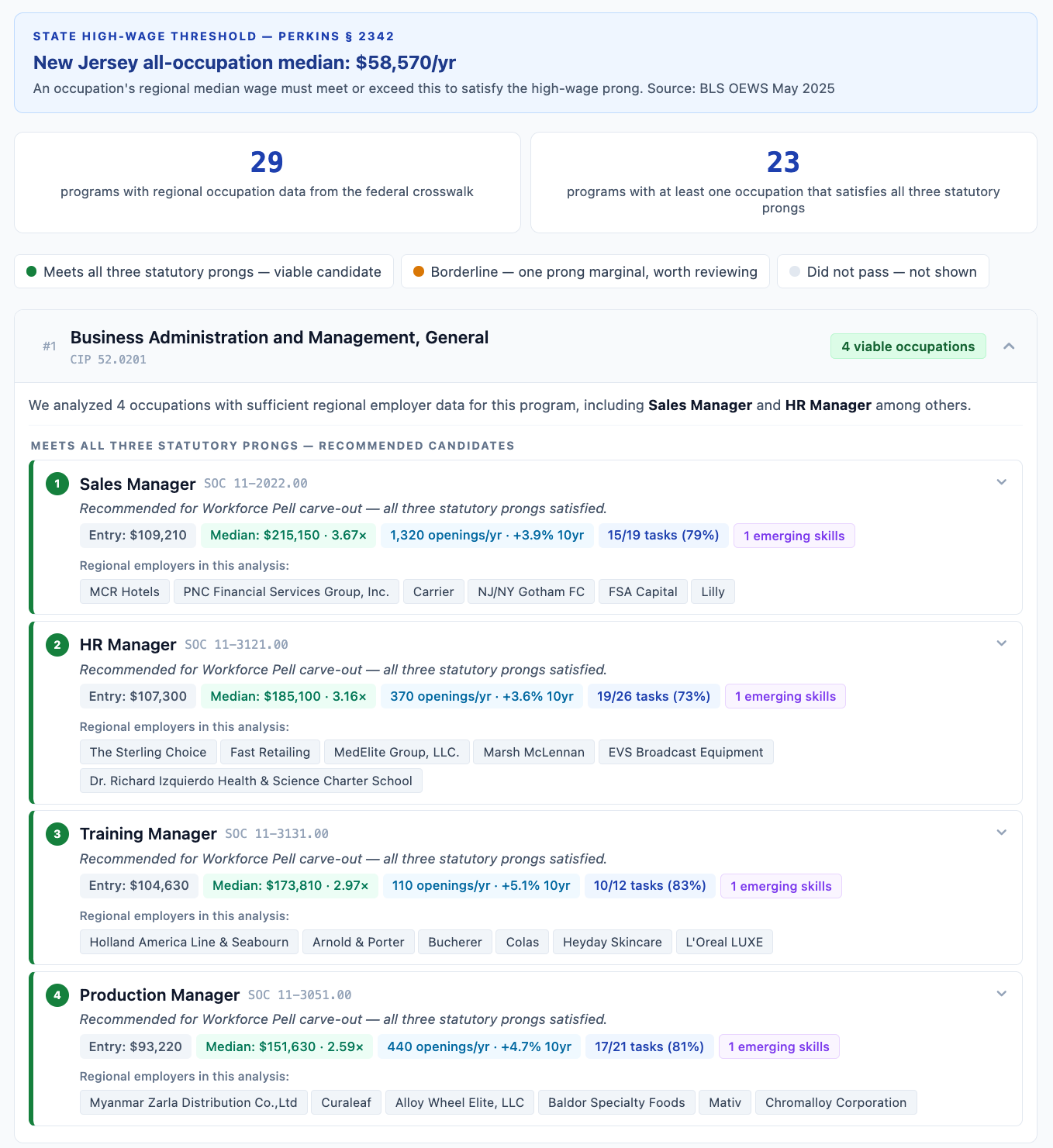
Occupation candidates with wage, demand, and task coverage
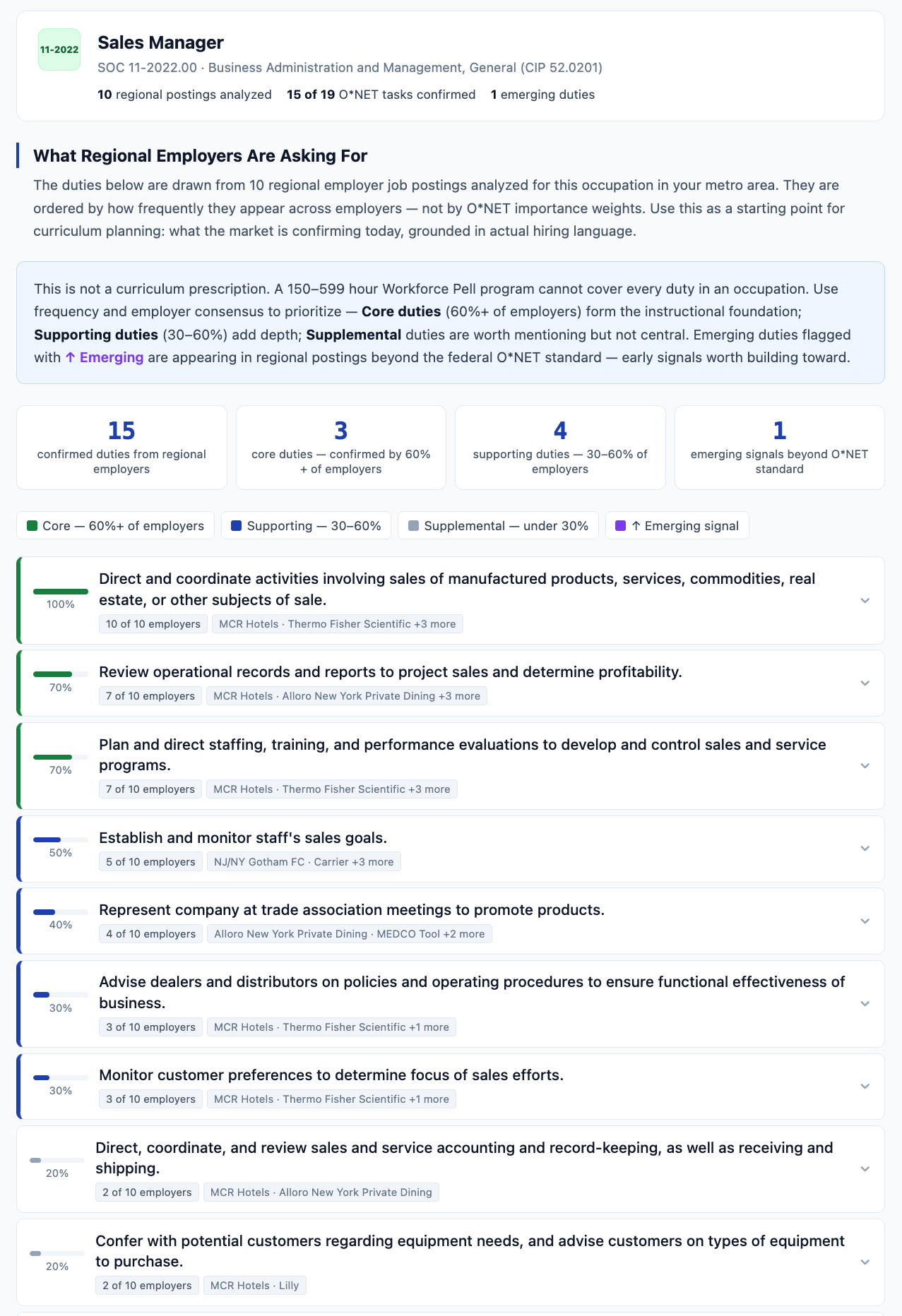
Duties ranked by employer frequency with emerging signals flagged
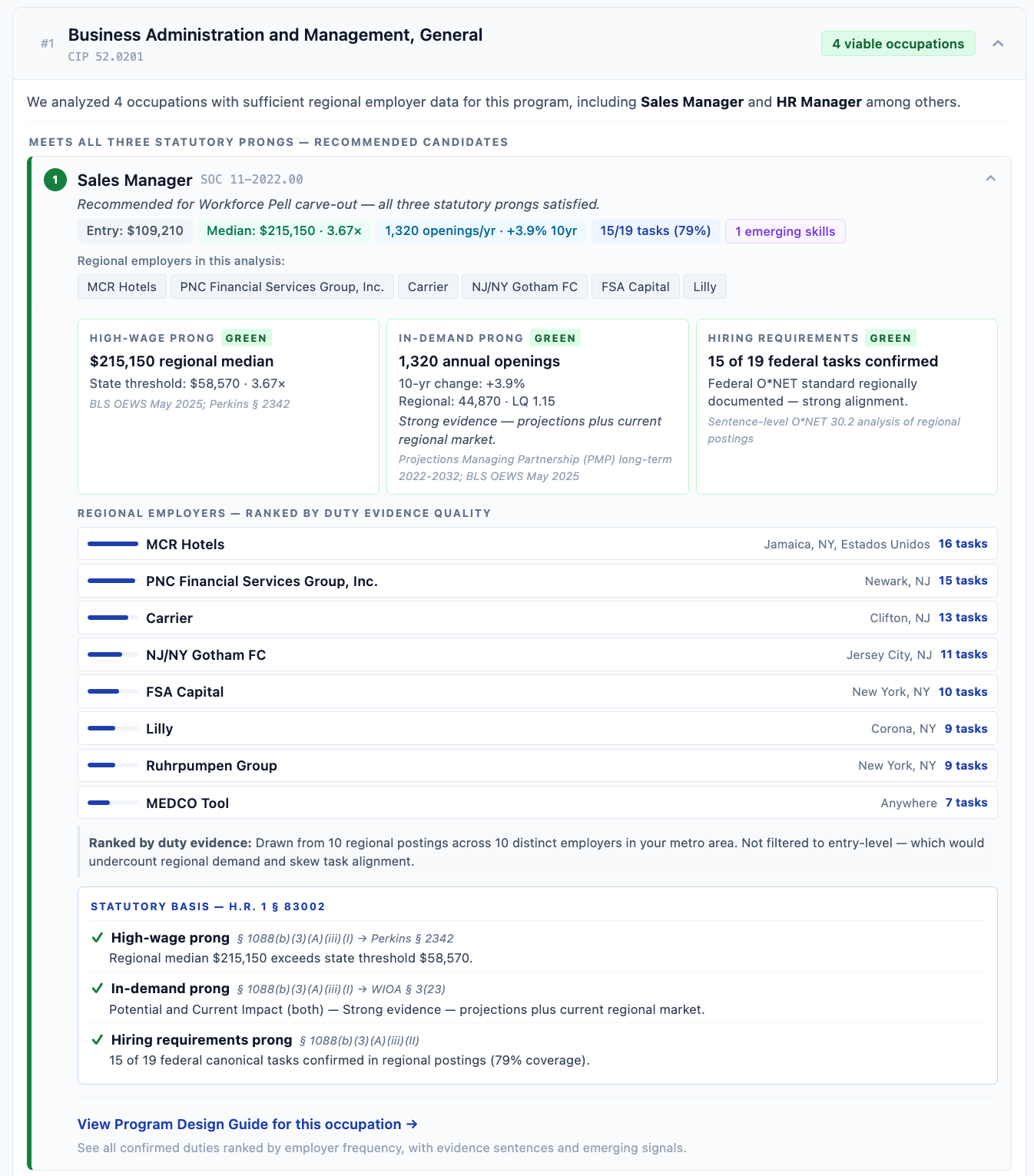
Three green prong cards with statutory citations and employer evidence
Stage 1 — Job Title Testing
Every occupation tested against real postings in your metro — with every title tried and every result recorded
The federal crosswalk maps your programs to candidate occupations. For each one we screen regional job postings in your metro — using the title employers actually post, not the formal BLS label. If a title returns thin results, we retry with an alternate in a second round. The full history is recorded: which title was tested, how many postings came back, and what we concluded. When a specialty role like Radiologic Technologist returns zero results across multiple titles and locations, we document that as a data source limitation — not a market absence — so a state reviewer sees the distinction.
Stage 2 — Qualifying Occupations
Which of your programs have occupations that clear all three statutory prongs?
Every program in your IPEDS catalog is checked against the high-wage, in-demand, and hiring requirements prongs. Programs with at least one viable occupation surface to the top — borderline cases are flagged for review, not silently excluded.
Stage 3 — Occupation Comparison
Compare every candidate occupation side by side — wages, demand, task coverage, and named regional employers
Each candidate occupation shows entry and median wage, annual openings, 10-year growth, and task coverage against the federal O*NET standard. The regional employers whose postings anchor the analysis are named — so the selection is documented, not guessed.
Stage 4 — Curricular Evidence
Duties ranked by employer consensus, ready to inform your curriculum
Core duties — confirmed by 70%+ of employers — form the instructional foundation. Supporting and supplemental duties add depth. Emerging duties flagged by multiple employers but not yet in the O*NET standard show where the field is moving. Every duty traces back to specific employer postings reviewers can verify.
Stage 5 — Statutory Proof
Three prongs. Three green lights. Every claim sourced to statute.
The high-wage, in-demand, and hiring requirements prongs are documented with the actual figures that satisfy each — regional median wage against the state Perkins § 2342 threshold, annual openings with location quotient, task coverage against O*NET. Statutory citations included. Reviewers can verify every number.

See a live program design guide

Live sample

We don't just identify which in-demand occupations align to your approvable programs — we go occupation by occupation, clarifying the specific tasks to guide short-program development. Here's one done in full: Production Manager at North Central Texas College, built from publicly available job postings in a recent regional sweep.

Open the live sample → No login. Real employers, real posting language.

Before your state's next window

Send your catalog and your state. Within a week you'll know which programs qualify now, which are near-misses and what they're missing, and which don't fit.

Request a Readiness Review