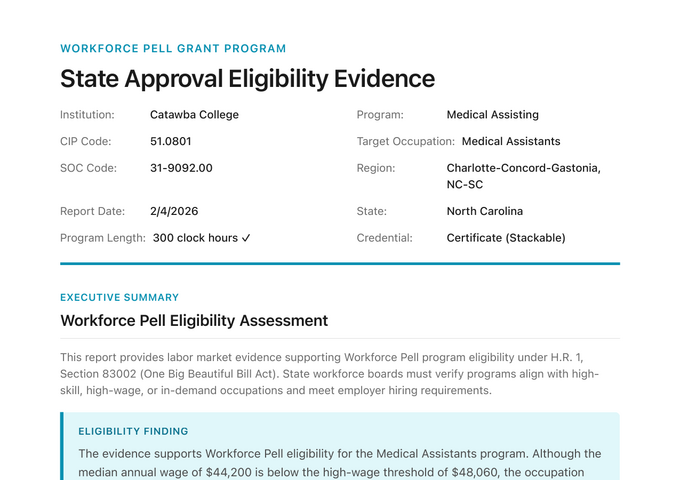
Workforce Pell
Workforce Pell extends federal Pell Grant eligibility to short-term training programs (8–15 weeks). To qualify, programs must prove they lead to high-wage, in-demand occupations with at least 70% completion and placement rates. This report builds that evidence package for state workforce board approval.
- In-demand occupation documentation
- Wage threshold verification
- Credential-to-employment pathway
- State workforce board criteria alignment
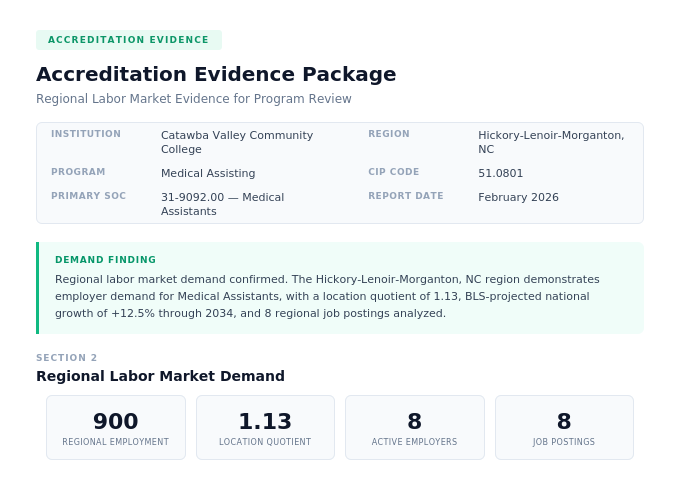
Accreditation Evidence
Regional and programmatic accreditors (SACSCOC, HLC, ACEN, ABET, etc.) increasingly require institutions to demonstrate that programs align with labor market demand. This report provides the external labor market sections for self-study narratives and program reviews — every claim tied to a federal source or employer posting.
- Regional demand and growth projections
- Employer requirement documentation
- Program-to-occupation alignment evidence
- Wage and employment outcome data
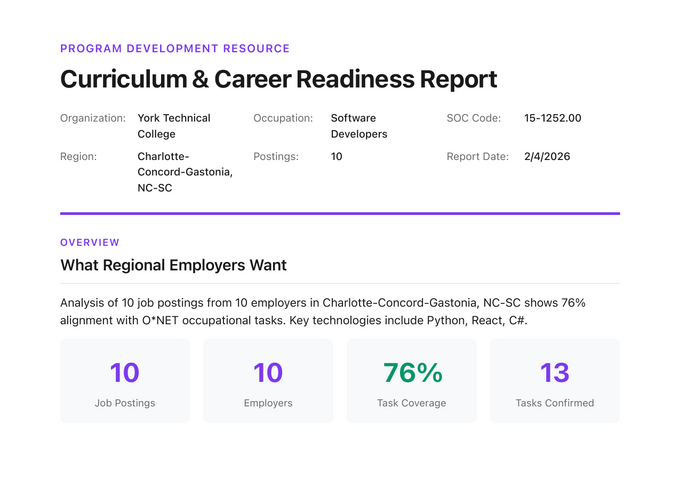
Curriculum & Career Readiness
Analysis for faculty and career services. Identifies gaps between curriculum and employer expectations, plus job search preparation for students.
- Task gap analysis vs. O*NET standards
- Emerging skill requirements from postings
- Resume keywords employers actually use
- Interview preparation topics
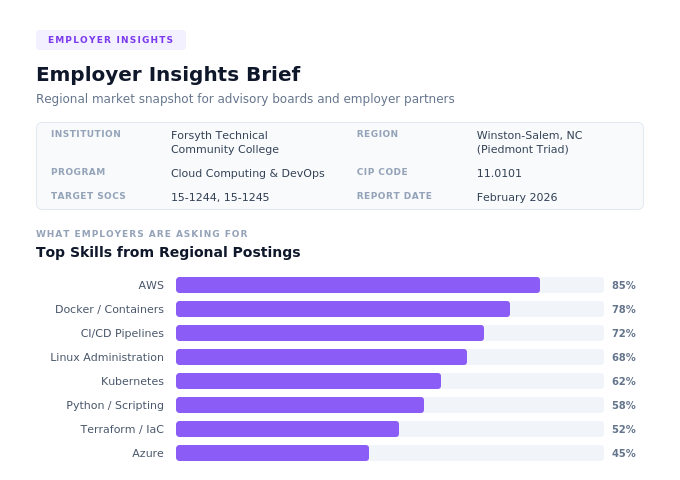
Employer Insights Brief
Regional market snapshot for advisory boards and employer partners. Summarizes what local employers are looking for and how programs can respond.
- Top employer requirement trends
- Regional hiring pattern analysis
- Skill demand vs. program output comparison
- Advisory board discussion talking points
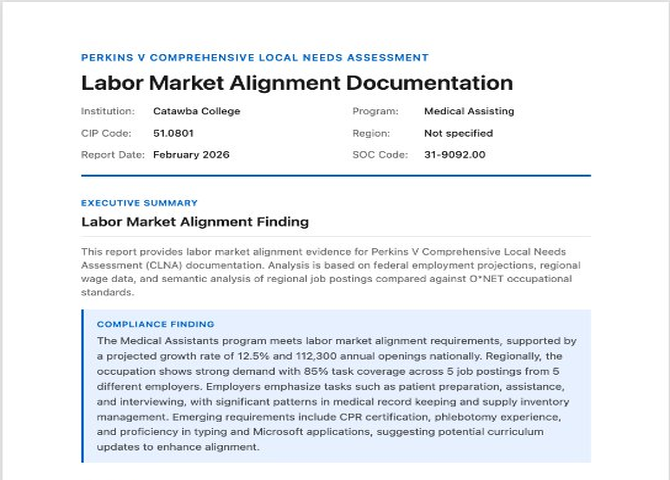
Perkins V CLNA
Perkins V funds career and technical education at community colleges, technical schools, and high schools. To keep that funding, institutions must complete a Comprehensive Local Needs Assessment every two years — proving their programs align with in-demand, high-skill, or high-wage occupations using actual labor market data. This report is that documentation.
- Regional employment projections from BLS
- Wage percentiles from OEWS
- Skill alignment with O*NET task analysis
- Employer requirement evidence from job postings
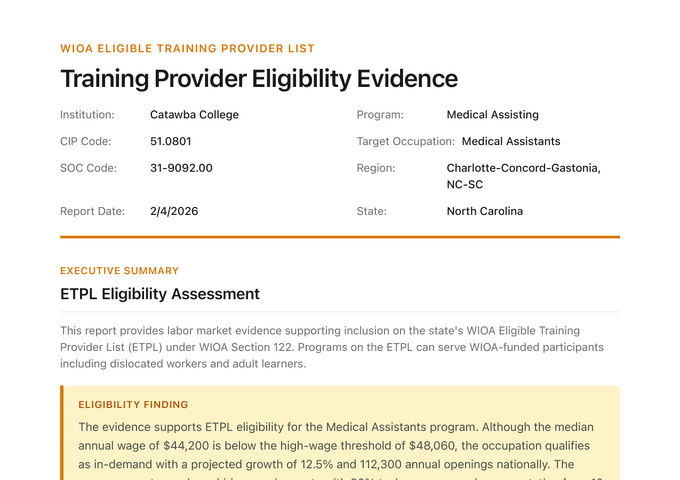
WIOA ETPL
The Workforce Innovation and Opportunity Act funds job training through state workforce boards. To receive WIOA funding, your program must be on the state's Eligible Training Provider List — which requires proving the training leads to in-demand occupations with recognized credentials. This report provides that labor market evidence.
- In-demand industry sector evidence
- Employment outcome alignment
- Regional labor market demand
- Performance accountability documentation